Underwater MIPs: What they are, Why they happen, and What to do next
A Management Incentive Plan (MIP) is meant to give senior leaders a share of the value they help create in a private equity-owned business. The idea is simple: if the company grows and investors do well, management should also participate in the upside.
The problem starts when the value of the business is no longer high enough for that upside to reach management. For example, a leadership team may hold 10% of the equity on paper. But if the exit proceeds are fully used to repay debt, return investor capital and meet the agreed hurdle, there may be nothing left for the management pool. The plan still exists, but it no longer has economic value. That is an underwater MIP.
This is becoming more common as holding periods stretch, exit markets remain selective and deal assumptions made at entry no longer match current valuations. For sponsors and portfolio boards, the issue is not only technical. Once management can see that the original plan is unlikely to pay out, the incentive loses much of its power to retain, motivate and align the team through the next phase of the investment.
Why This Is Happening Now
Private equity is emerging from a three-year slump into a narrower, more demanding recovery. According to the 2026 Global Private Equity Report by Bain and Company, Global buyout-backed exit value jumped over 45% year-over-year to more than US$700 billion in 2025, but a handful of US megadeals accounted for a large share of that total.
Beneath those headlines, most portfolio companies face a tougher reality: fundraising is subdued, liquidity is tight, and exit markets are selective rather than broad-based.
Distributions to investors have sat below 15% of net asset value (NAV, the current value of a fund’s underlying holdings) for several years, average holding periods at exit are around seven years, and sponsors are carrying a long tail of unsold companies. Extended holds and slower exits are dragging on internal rates of return (IRR, the annualised return on invested capital), particularly once assets move past the seven-year mark. These are directional market indicators rather than precise figures and are worth verifying against the most recent data before quoting.
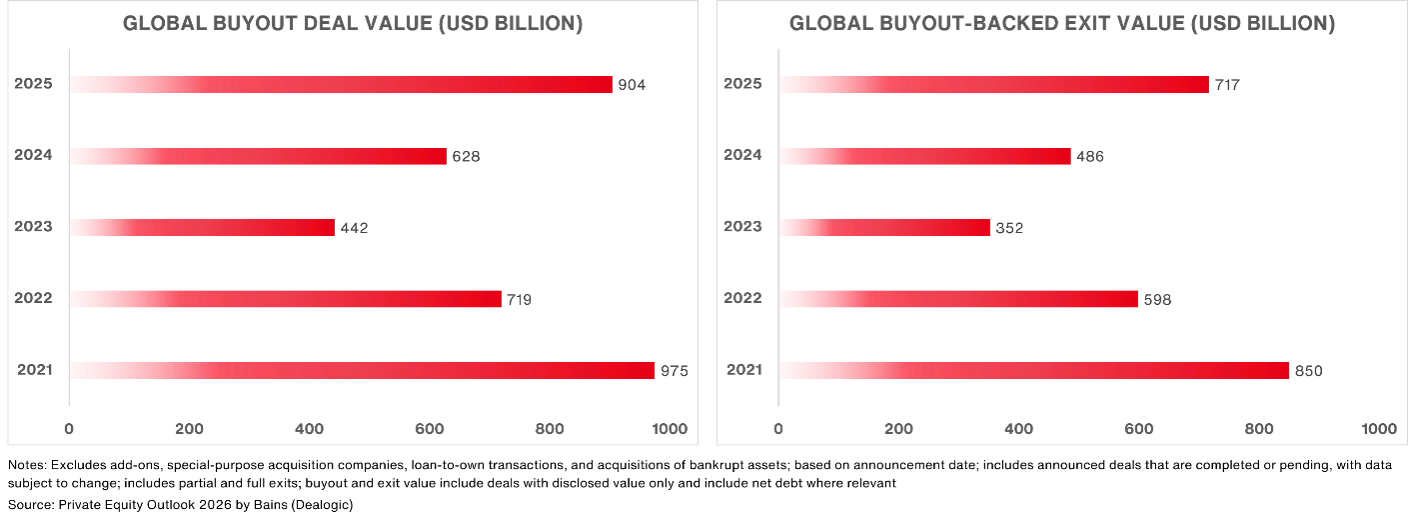
This mix (longer holds, high entry prices, elevated rates and uneven recovery outside the megadeal tier) means more deals where the underwriting case is off track. In those situations, a MIP calibrated, say, to a 3.0x outcome over five years can suddenly be deeply out of the money.
India is on a different but related path. Deal volumes declined by ~8% in 2025 while total transaction value increased by 23%, resulting in a 34% jump in average deal size. This showcases India’s private equity landscape is transitioning into a more disciplined and mature environment, with investors placing greater emphasis on quality and scalability and directing capital toward a smaller number of larger, high-conviction opportunities. For Indian sponsors, that concentration matters here: fewer, larger, more scrutinised assets mean each portfolio company carries more of the fund’s return, and the management teams running them are exactly the people whose incentives cannot afford to go dead mid-hold.
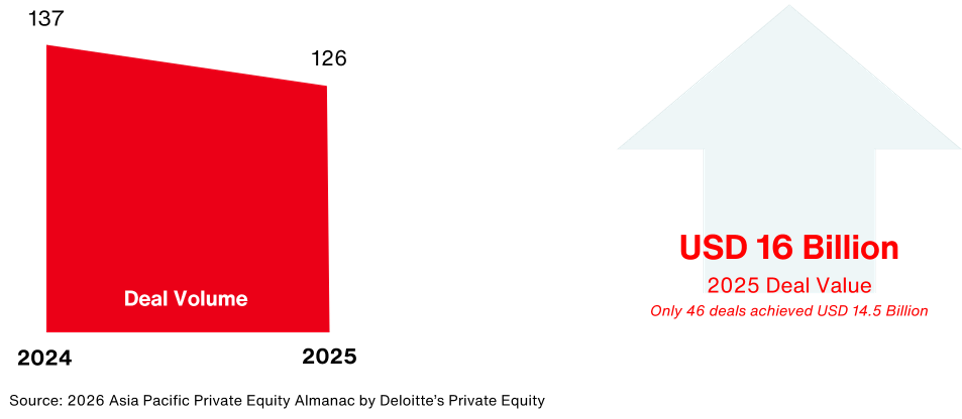
India: deal volume and deal value, 2024–2025.
What is an MIP and why does it exist?
Management Incentive Plans are deal-specific equity arrangements that give a company’s senior team a defined share of upside when private equity owners exit. Rather than a broad, policy-driven ESOP, a MIP is built into the transaction: a ring-fenced management pool (often in the high single digits to low-teens percent of fully diluted equity) that participates only after debt and investor capital have been repaid and a base return has been achieved. It may be implemented through options, growth shares, sweet equity or, in some markets, phantom or cash-settled equivalents.
The order of payment is what decides everything that follows. The exit waterfall below is the reference point for the rest of this article.
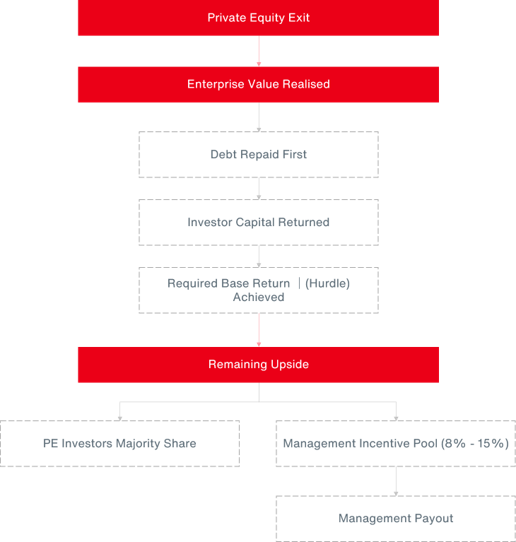
The exit waterfall: management participates only in what remains after debt, investor capital and the hurdle.
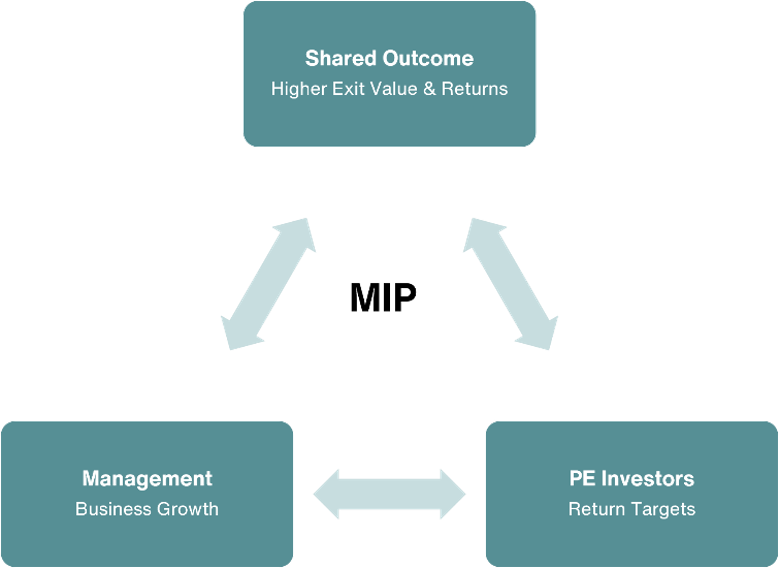
PE firms use MIPs to solve an alignment problem. Their model relies on leverage, finite holding periods and ambitious return targets that depend heavily on a small group of leaders. A well-structured MIP concentrates meaningful upside in that group: if the fund delivers its case, say, a 2–3x equity multiple (multiple on invested capital, or MOIC, the ratio of value returned to capital invested) over five to seven years, management can realise a significant payout; if returns fall short, the plan may pay little or nothing.
MIPs turn the PE deal model into a pay mechanism: They link leadership wealth to investor outcomes.
They also help attract executives willing to take on the demands of running a PE-backed business.
The Management–Investor Alignment Engine
How MIPs go Underwater
Referring to the waterfall, a plan goes underwater when nothing meaningful reaches the management pool in realistic exit scenarios. That usually reflects a combination of factors.
- Business underperformance – Revenue, margins, cash generation or synergies fall short, so enterprise value at exit is materially below plan. Most or all the equity is then needed just to repay invested capital and the preferred return, with nothing left for management.
- Multiple compression and macro shocks – Sector valuation multiples fall because of higher rates, public-market re-ratings, regulation or geopolitical risk. The company may be better run than at entry, but the market pays less per unit of EBITDA or revenue, leaving only a thin slice of residual equity once debt and preferred instruments are covered.
- Aggressive entry pricing or leverage – High entry multiples or heavy debt stacks leave only a narrow band of outcomes in which ordinary equity, and therefore the MIP, receives meaningful value. If reality lands below that band, the waterfall is largely consumed by debt repayment and the return of capital.
- Extended holding periods – Holds that stretch from four to five years out to seven to nine because of weak exit markets or refinancing delays make IRR targets harder to hit simply because more time passes without a matching increase in enterprise value. Plans with fixed hurdles or time-weighted preferred returns can end up out of the money even if equity value is flat to slightly up.
- Plan design – High option strike prices or very demanding IRR/MOIC hurdles mean management only participates at elevated equity values. If the deal lands in the middle, the MIP can still be out of the money.
Worked Example: How a MIP goes Underwater in the Exit Waterfall
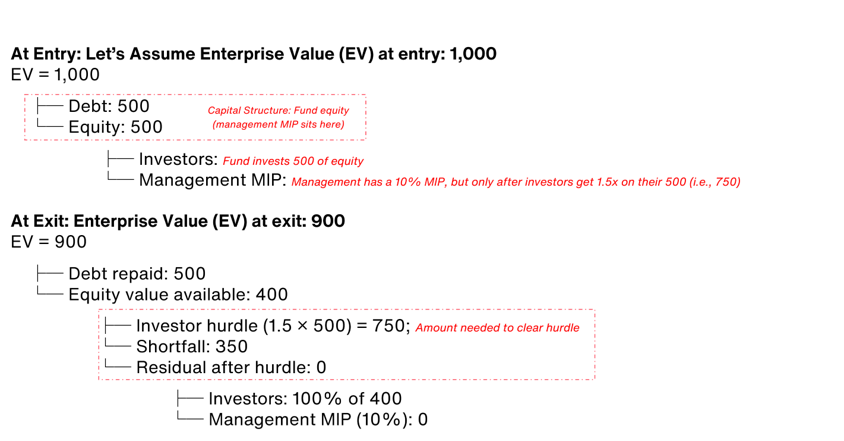
- On paper, management holds 10% of the equity
- In practice, all 400 of equity values at exit goes to investors and still doesn’t reach the 750 hurdle
- Nothing flows to the MIP → the plan is economically underwater
In our work with sponsors and portfolio boards, the practical warning sign comes earlier than the exit itself: updated forecasts show that even in a sensible upside case, investor capital and preferred returns absorb almost all the equity in the waterfall. If the model only gives management real value in a blue-sky scenario, the MIP is already on the verge of being underwater.
What Breaks When a MIP Goes Underwater
Once a MIP is out of the money, a predictable set of dynamics follows.
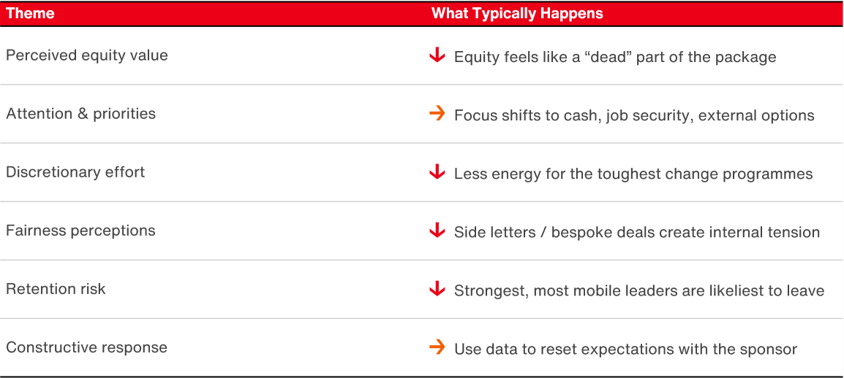
For the management team, the equity quickly becomes a lifeless part of the package. Under any plausible exit, leaders do not expect a payout, so the psychological value drops to zero: they stop counting it in their plans and refocus on cash compensation and external options.
As the risk–reward balance shifts, the equity no longer justifies PE-level intensity. Discretionary effort on the hardest change programs falls, quiet exploration of alternatives rises, and perceived unfairness can grow if some are protected by side letters or bespoke terms while others are not. We have observed that stronger leadership teams use this as a trigger for a data-driven discussion with the sponsor about whether the current plan still makes sense for the next phase of the investment.
Management Response Pattern
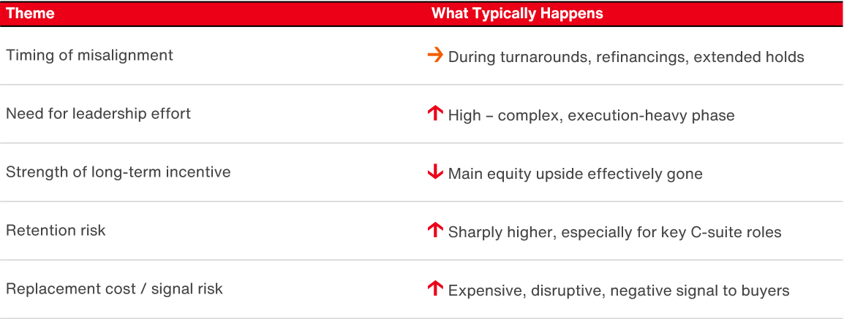
For the PE sponsor, the board and investors, these reactions create hard challenges, and they arrive at exactly the wrong time. Underwater MIPs tend to coincide with periods when the asset most needs focused leadership: turnarounds, cost resets, complex refinancings or extended holds. The fund still needs management to deliver a demanding plan, but the main long-term incentive meant to support that effort has gone. Retention risk spikes, particularly among the strongest executives. Replacing a CEO or CFO mid-hold is expensive and disruptive and can further depress buyer confidence and valuation.
Sponsor and Board Tension Points
Governance optics also become more delicate. Leaving a dead plan untouched is simple from a dilution perspective but risky for value creation. Resetting or topping up the MIP to restore upside can be seen as “rewarding failure” if it is not carefully designed and explained, especially when underperformance is in close review. Boards must weigh stewardship of investor capital against the reality that no upside usually means weak incentives and a higher risk of further value erosion.
How a sponsor handles underwater MIPs also shapes its reputation in the senior talent market and, over time, with sellers and advisers. A firm known for letting management equity die without any attempt to realign incentives will see strong candidates discount or avoid its offers, and vendors question its ability to attract and keep top teams. That affects not only the current deal but the sponsor’s broader employer and partner brand.
The Four Levers for Managing Expectations and Retention
Once a MIP is out of the money, the real work on incentives begins. The team that knows the asset best is still needed to deliver a second-phase value-creation plan, but the original equity promise is no longer credible. Firms that manage this well do not simply push through; they re-cut the economics so there is again a clear, performance-linked upside from this point forward, within a dilution and governance envelope investors can accept. Four levers tend to matter most.
1. Reset the hurdles, not the history
What it is: Re-basing IRR (Internal Rate of Return), MOIC (Multiple on Invested Capital) or equity value thresholds so participation starts from today’s fair value and today’s plan, rather than a vanished base case. Technically, sponsors adjust the “carry-in” point for management: below it, investors take all residual equity; above it, revised sharing mechanics apply.
When to use it: Where the plan was struck off a business plan that did not contemplate prolonged underperformance or extended holds, and unchanged hurdles would leave an otherwise viable plan permanently out of the money.
The trade-off: It does not recreate the economics management would have enjoyed had the original underwrite been met; it only defines how new value from the current baseline is split, and it has to work within tax, securities law and consent constraints.
2. Add a new layer of upside
What it is: A fresh, smaller class of growth shares, options or economically equivalent instruments issued to management, participating only above today’s equity value and on revised timing and performance expectations.
When to use it: Where the original MIP is structurally underwater, heavily diluted or difficult to amend. The legacy plan stays intact with whatever residual option value it has, and the new layer can be modelled independently.
The trade-off: The sponsor accepts additional dilution in good outcomes as the price of a re-energised team in all outcomes where capital remains at risk.
3. Balance equity with targeted cash
What it is: Multi-year cash or phantom equity plans linked to deleveraging, EBITDA or liquidity milestones, or deal-contingent bonuses payable on a refinancing, asset sale or agreed minimum equity value.
When to use it: In stressed or transitional situations where exit timing has already slipped and long-dated equity alone is rarely enough; these designs are easier to implement and explain in the near term.
The trade-off: These instruments usually sit outside the capital structure and are taxed as employment income—less efficient than capital gains, but often accepted for speed and certainty. They recognise added execution risk; they do not replace equity.
4. Refocus the pool on the team needed now
What it is: Re-examining who participates and at what level: increasing stakes where a role is pivotal to the second phase, bringing critical hires in on coherent terms, and cleaning up legacy entitlements for those no longer central to delivery. Technically, this means revisiting vesting, good/bad leaver provisions and rollover expectations.
When to use it: After longer holds have changed the senior bench—original participants have left, new hires have arrived, and the roles that will drive value over the next three to five years are not the ones that mattered at entry.
The trade-off: It requires difficult conversations about legacy entitlements, but it creates a smaller, sharper pool in which each percentage point of upside feels more meaningful.
None of these moves is cost-free. Each implies some combination of additional dilution, valuation work, tax and regulatory analysis, and difficult conversations with management, co-investors and sometimes lenders.
Leaving a dead plan untouched is rarely neutral.
It means asking a management team to deliver a demanding plan on an incentive structure that no longer reflects the economics of the deal. In an environment of extended holds and uneven exits, the sponsors most likely to keep their best leaders engaged are those prepared to use these levers in combination. That means resetting hurdles, overlaying new upside, using targeted cash where appropriate, and refocusing the pool on the people who matter now. Done within a disciplined governance and dilution framework, it gives sponsors a realistic chance of turning challenged investments into acceptable outcomes.
What Sponsors Should Pressure-Test
When a MIP goes underwater, the question is rarely whether management should simply get more. The better question is whether the current plan still reflects the economics, risks and leadership priorities of the next phase. Sponsors need a clear view of where value breaks in the waterfall, which outcomes are still realistic, and what level of revised upside would restore alignment without creating avoidable dilution or governance concerns.
- Model the current waterfall to understand where management value has eroded and whether any meaningful upside remains in realistic exit scenarios.
- Test alternative structures across hurdle resets, new growth-share or option layers, and targeted cash or phantom equity bridges.
- Test alternative structures across hurdle resets, new growth-share or option layers, and targeted cash or phantom equity bridges.
- Refocus participation on the leaders most critical to the next phase of the investment, especially where the senior bench has changed since entry.
If a plan in your portfolio is already out of the money, start with the waterfall: talk to Aon’s Executive Compensation team about modelling where the value has gone and what it would take to restore it.
Contact Us [email protected]